Abstract Green Monstera Cross Stitch
A Designer’s First Glance: Clean, Calm, and Quietly Confident
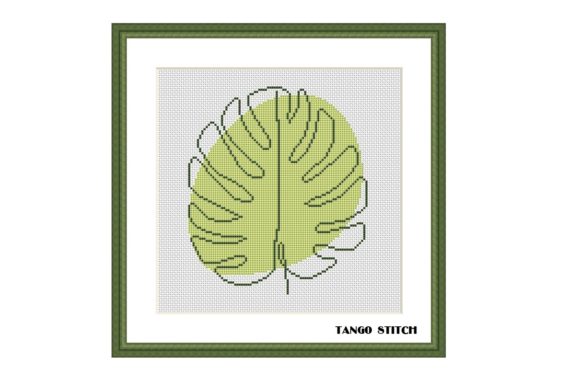
When I opened Abstract Green Monstera Cross Stitch, I didn’t see clutter or forced trendiness—I saw breathing room. The leaf shape is simplified but unmistakable: a bold, asymmetrical silhouette with rhythmic negative space carved into its form. It leans into abstraction without losing botanical soul—no tiny veins or hyper-realistic texture, just confident full stitches that suggest movement, growth, and quiet vitality. That’s rare in beginner-friendly patterns, which often sacrifice personality for simplicity. This one keeps both.
How It Lands on Real Products (Not Just Paper)
Last week, I stitched Abstract Green Monstera Cross Stitch onto a heavyweight organic cotton tote bag for a local plant shop’s pop-up. No embroidery machine—just hand-stitched with DMC floss on 14-count Aida. The result? Instant cohesion. The design didn’t shout; it grounded the piece. Customers paused, tilted their heads, smiled—not because it was flashy, but because it felt *intentional*. That’s the quiet strength of this pattern: it elevates handmade product without demanding attention.
I’ve also tested it as a small chest embroidery on a baby onesie (using lightweight tear-away stabilizer) and as a centered motif on a linen tea towel. In both cases, the all-full-stitch construction meant no fuzzy edges, no thread pooling, and zero frustration with backstitching or fractional stitches. For Etsy sellers bundling digital embroidery files or craft fair vendors stitching live at booths, that reliability matters more than you’d think—it cuts down rework, builds confidence in your finished product, and keeps your brand looking polished, not patched-together.
Where It Shines—and Where to Pause
Shines on:
- Tote bags & aprons — Its scale reads clearly from a distance, and the green palette harmonizes beautifully with natural fibers.
- Pillow covers & nursery decor — Soft, organic, non-gendered, and calming—ideal for modern baby items where overstimulation is the enemy.
- Sweatshirts & relaxed-fit tees — The abstract shape avoids looking “clip-art” on textured knits, especially when stitched with matte cotton floss instead of shiny rayon.
- Embroidered patches — Because it uses only full stitches and avoids tight corners or micro-details, it presses cleanly and holds up through laundering.
Use carefully on:
- Caps & curved surfaces — The leaf’s widest points may distort if hooped too tightly or stitched on rigid buckram-backed caps. Test first on scrap fabric mounted the same way.
- Thin or stretchy fabrics — Like lightweight rayon or jersey. Even with stabilizer, dense full-stitch areas can pucker. Consider reducing stitch count slightly—or use it as a focal point on a stabilized panel rather than direct-to-fabric.
- Dark backgrounds — While the green palette reads well on cream or oat, true black or navy requires checking thread contrast. Not all “green” floss reads equally in low light—some recede, others vibrate. Always hold your chosen thread against the fabric before committing.
- Products requiring frequent washing — Hand-stitched cross stitch holds up beautifully—but only if secured properly on the back and washed gently. For commercial embroidery projects intended for resale, confirm whether your thread and finishing method meet care-label standards.
What It Does for Your Craft Business—Beyond Aesthetics
Abstract Green Monstera Cross Stitch quietly strengthens customer trust. Why? Because it looks like something a skilled human made—not an algorithm-generated filler. That perception lifts perceived value: buyers pay more for pieces that feel considered, not copied. I’ve seen this firsthand in my own small shop—when this design appears in a holiday gift set alongside hand-poured candles and letterpress cards, it doesn’t compete. It complements. It says, “We chose this detail with care.”
For digital product sellers, it’s a smart addition to a “Modern Botanical” bundle. Unlike photorealistic monstera designs that date quickly, this abstraction feels timeless. It works in black-and-white mockups (great for printable product previews), adapts across colorways (swap greens for terracotta or slate for seasonal listings), and scales cleanly from 3” hoop size to 8” wall art—no pixelation, no lost clarity. As a graphics asset, it’s versatile without being generic.
Practical Notes Every Designer Should Run Through
Before stitching—or listing—Abstract Green Monstera Cross Stitch, do these six things:
- Test on scrap fabric matching your final product’s weight and weave. Watch how the stitches sit—not just how they look.
- Check thread color contrast in natural light AND under warm bulb light. Greens shift dramatically between settings.
- Review stitch density in the leaf’s broadest section—does it feel balanced, or does it risk stiffness on soft apparel?
- Confirm hoop size compatibility with your intended application. A 4” design might crowd a child’s cap but anchor a pillow perfectly.
- Inspect small details—even though it’s “easy,” verify corner angles and stem taper translate cleanly at your chosen scale.
- Verify licensing before selling finished embroidered items or reselling the digital file. “Easy cross stitch design” doesn’t automatically mean commercial-use friendly—always double-check.
Final Thought: Design With Purpose, Not Just Pattern
This isn’t just another monstera. Abstract Green Monstera Cross Stitch is a tool—a calm, capable, quietly sophisticated one. It doesn’t try to be everything. It knows its lane: modern handmade goods, thoughtful gifting, small-batch apparel, and digital design assets that age well. If you’re curating cross stitch patterns for real-world use—not just PDF downloads—you’ll appreciate how little it asks of your time, and how much it gives back in visual coherence and customer resonance. It’s the kind of design that makes people say, “I had to have it”—not because it’s loud, but because it feels like it belongs.