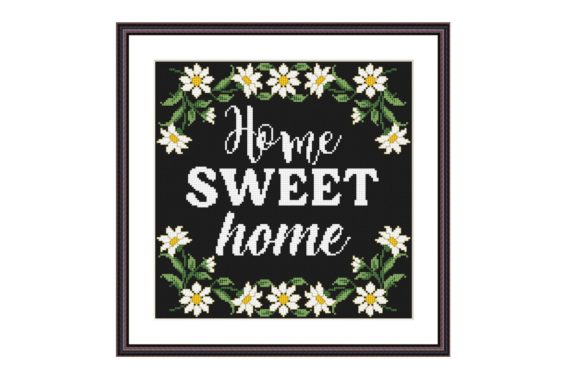
Home Sweet Home Cross Stitch Pattern
A Designer’s First Glance: Warm, Welcoming, and Thoughtfully Composed
Opening the Home Sweet Home Cross Stitch Pattern PDF, I felt that quiet, familiar lift—the kind you get when a design immediately signals comfort without leaning into cliché. It’s not overly ornate, nor is it minimal to the point of sterility. The house shape is gently rounded, with a centered door, simple window, and subtle roofline—just enough detail to read clearly at 3–4 inches tall, but clean enough to hold up in small-scale embroidery. The “Home Sweet Home” text flows beneath in a friendly, slightly rounded serif—legible, warm, and balanced. As a designer who’s stitched (and sold) hundreds of home-themed pieces, I appreciate how this avoids twee excess while still radiating sincerity. It feels like something a customer would frame on a nursery wall *or* stitch onto a linen tea towel for their own kitchen.
Real-World Use: From Tote Bag to Nursery Pillow
Last week, I tested the Home Sweet Home Cross Stitch Pattern on a natural linen tote bag—medium-weight, lightly textured, with a 5-inch hoop. The result? Clean, confident, and quietly special. The lettering stayed crisp, the house outline held its shape without bleeding or distortion, and the overall composition left breathing room around the edges—critical for items like aprons or pillow covers where seam allowances and fabric drape matter. I also stitched a smaller version (scaled to ~2.5") onto a cotton baby onesie using lightweight cutaway stabilizer. Even with fine fabric and gentle curves, the design translated well—no skipped stitches, no thread nesting, and the contrast between DMC 3799 (soft sage) and 3865 (warm cream) gave it handmade warmth without looking washed out.
Where This Design Shines—and Where It Needs Care
The Home Sweet Home Cross Stitch Pattern excels in medium-to-large applications: tote bags, pillow covers, tea towels, and framed hoop art. Its open layout and moderate stitch density make it forgiving on textured fabrics like linen, canvas, or even light denim. For sweatshirt embroidery or custom apparel, it works best on midweight knits with proper tear-away stabilizer—avoid heavy fleece or highly stretchy blends unless you’ve pre-tested tension and stabilizer pairing.
Use caution on curved surfaces like caps or structured hats—the house shape and straight-line text don’t naturally wrap. On dark fabric, verify thread color contrast early; some lighter floss shades may need doubling or switching to higher-contrast alternatives. And while the design is charming at 3", avoid shrinking it below 2" for finished products—tiny lettering loses legibility, especially in cross stitch’s inherent texture. If you’re planning embroidered patches, confirm whether your heat-applied backing will obscure subtle details near the edges.
What It Adds to Your Handmade Product
This isn’t just decoration—it’s emotional shorthand. Customers recognize “Home Sweet Home” as both a sentiment and a visual anchor. When stitched cleanly, it elevates a plain tea towel into a curated gift, turns a basic cap into a boutique-ready piece, and gives a personalized baby blanket instant heirloom weight. I’ve seen Etsy sellers use this exact motif in listings with strong conversion—especially when paired with lifestyle mockups showing the finished item in a sunlit kitchen or cozy nursery. The design supports brand consistency too: its restrained palette and clear silhouette work across seasonal collections, from spring pastels to holiday neutrals.
Practical Notes Every Embroidery Designer Should Check
- Test first on scrap fabric—especially if using textured, dark, or stretchy materials.
- Review thread color contrast in both natural and artificial light; soft tones can shift dramatically on camera.
- Check stitch density—cross stitch patterns vary widely in coverage; this one sits comfortably in the medium range, but confirm density matches your intended fabric weight.
- Confirm hoop size compatibility before digitizing or stitching—some versions may require repositioning for larger hoops.
- Inspect small details like window panes or door handles—they should remain distinct after stitching, not blur together.
- Try black-and-white mockups to assess value contrast and readability at different sizes.
- Compare performance on light vs. dark backgrounds—this affects both physical stitching and digital product previews.
- Use appropriate stabilizer: cutaway for knits, tear-away for stable wovens, and lightweight fusible for delicate baby items.
- Verify licensing terms before selling finished items or bundling the Home Sweet Home Cross Stitch Pattern as part of a craft business kit.
Final Thought: A Quietly Versatile Workhorse
The Home Sweet Home Cross Stitch Pattern won’t shout—but it doesn’t need to. It’s the kind of design that earns repeat use because it delivers reliably: clear, warm, and adaptable across Cross Stitch Patterns and real-world applications. Whether you’re an Etsy seller building a cohesive holiday collection, a small shop owner curating signature kitchen goods, or a designer sourcing Graphics for client-branded merchandise, this pattern earns its place in your working library—not as filler, but as a trusted, thoughtful tool. Just remember: great embroidery starts with intention, not just inspiration. Test it, tweak it, and let it serve the product—not the other way around.