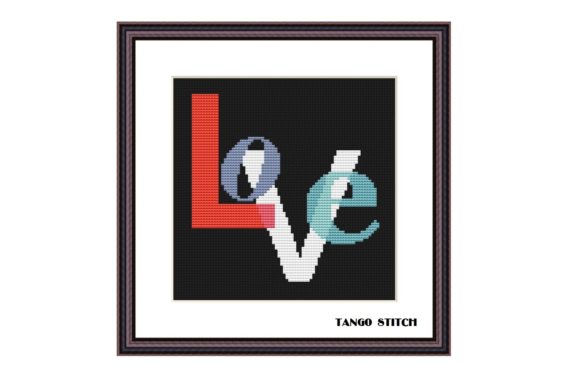
Love Typography Romantic Cross Stitch
A Practical Review for Small Business Merchandise & Branded Patches
As an embroidery designer who’s developed hundreds of commercial patterns for cafés, boutiques, florists, bakeries, and handmade brands, I approach every new design with two questions: Does it translate clearly at scale? and Does it reinforce brand identity—not just decoration? When I first saw Love Typography Romantic Cross Stitch, my instinct was cautious optimism. The title suggests warmth and intention; the description—“simple cross stitch design… uses only full stitches… suitable for beginner and exp”—signals accessibility and production reliability. That matters deeply when you’re stitching 50 aprons for a local coffee roastery or embroidering 200 tote bags for a wedding florist’s pop-up shop.
First Impression: Elegant Simplicity with Commercial Flexibility
Love Typography Romantic Cross Stitch reads as elegant, modern, and quietly confident—not fussy, not overly ornate, but unmistakably handmade in spirit. It avoids cutesy clichés (no hearts-with-wings or scripted swirls) and leans into clean typographic rhythm. That makes it unusually versatile for small business use: a florist can pair it with sage linen aprons; a pet wellness brand can place it subtly on kraft tote bags; a ceramic studio can stitch it onto limited-edition packaging tags. It feels premium without pretension—a rare balance in cross stitch patterns intended for real-world branding.
Where It Shines in Real Business Applications
- Embroidered patches: Its full-stitch construction and open letterforms hold up beautifully at 2"–3" sizes—ideal for iron-on or sew-on chest patches on staff uniforms or boutique merchandise.
- Apron embroidery: Positioned above the pocket or centered on the bib, it adds quiet sophistication without competing with functional details.
- Cap embroidery: Works well on structured front panels (6-panel caps, dad hats) when sized to 2.25" wide—letter spacing remains legible, and no backstitching or fractional stitches complicate digitizing.
- Tote bag design: Stitches cleanly on cotton canvas and canvas-blend fabrics. Because it uses only full stitches, it avoids puckering common with complex fill areas—critical for large, flat surfaces that get folded and washed.
- Product packaging accents: Perfect for stitched labels on handmade soap boxes, tea tins, or candle sleeves—especially when paired with neutral thread colors (ecru on oat linen, charcoal on natural canvas).
- Customer gifts & event merch: Its romantic yet restrained tone resonates across demographics—ideal for bridal shower favors, anniversary giveaways, or local market booth swag.
Where to Use It Thoughtfully (Not Avoid)
While Love Typography Romantic Cross Stitch is highly adaptable, smart application means respecting its structure. Avoid placing it:
- Below 1.5" tall on curved surfaces (e.g., cap brims or sleeve cuffs), where letter spacing may compress visually;
- On heavily textured fabrics (like bouclé or thick tweed) without testing stabilizer layers first;
- Against very dark uniforms unless using high-contrast thread (e.g., bright white or cream on navy);
- In high-wash-frequency items (like kitchen towels) without confirming thread colorfastness—cross stitch thread isn’t always rated for industrial laundering.
Remember: simplicity doesn’t mean zero constraints. Its strength lies in clarity—not density. This isn’t a high-stitch-count machine embroidery design meant to mimic photorealism. It’s a graphic—designed to be read, remembered, and repeated across touchpoints.
Brand Identity Impact: More Than Just “Cute”
For small businesses, consistency builds trust. A well-placed Love Typography Romantic Cross Stitch becomes part of your visual language—reinforcing warmth, craftsmanship, and attention to detail. Unlike generic stock logos, it signals intentionality: you chose something handmade, tactile, and human-scaled. Customers notice that. A bakery using it on staff aprons and customer thank-you cards tells a cohesive story about care and authenticity. An Etsy seller embedding it into printable mockups for digital embroidery file buyers strengthens perceived value—it’s not just a download; it’s a ready-to-brand asset.
Crucially, it supports visual consistency across mediums. Whether stitched, screen-printed, or laser-etched onto wood tags, its clean outlines translate reliably. That flexibility makes it a smart anchor in your broader design assets library—especially if you’re building a suite of complementary patterns (e.g., seasonal variations or monogram add-ons).
Practical Embroidery Designer Notes Before Production
Before committing to bulk runs, run these checks:
- Test the pattern in black-and-white first—does letter spacing remain balanced? Are serifs or terminals clear at target size?
- Verify legibility at your smallest intended patch size (e.g., 1.75") on actual fabric—not just screen.
- Review thread color contrast: soft pastels work for boutique charm; bold neutrals (charcoal, deep rust, slate blue) elevate professionalism.
- Inspect spacing between letters—tight kerning can blur in dense embroidery; generous spacing preserves readability.
- Confirm hoop size compatibility with your embroidery machine or service provider—many small-batch shops require designs under 4"x4".
- Always test on real fabric with correct stabilizer—especially for stretchy or loosely woven materials like jersey or gauze.
- Create a physical or digital mockup for client approval before stitching begins—this prevents costly rework.
- Compare Love Typography Romantic Cross Stitch beside your existing logo, icons, and typography to ensure harmony—not competition.
- Confirm commercial licensing terms—since this is listed under Cross Stitch Patterns and Graphics, verify whether resale, derivative use, or branded merchandise rights are included.
Bottom line: Love Typography Romantic Cross Stitch isn’t just another Valentine’s-themed craft pattern. It’s a strategic, scalable, small-business-ready design—thoughtful in execution, flexible in application, and rooted in the values your customers already connect with: sincerity, craftsmanship, and quiet confidence. Use it intentionally, test rigorously, and let it do what great design should: speak clearly, stitch reliably, and represent your brand—every time.